
by Steven D. Brewer
Professional authors are in the business of writing. Before my first work was accepted for publication, I had the naive preconception that an author wrote something, then it was published, and then they wrote the next thing. I was surprised to discover how much else an author needs to do: pitch manuscripts, write query and submission letters, respond to editors’ comments, write bios and summaries, engage in book promotion, and even hand-sell books.
There are numerous opportunities for authors to sell books directly to an audience. Perhaps the most important are national and international conventions, such as Worldcon. Regional conventions are also worth attending. Additionally, there are often a vast number of local events that will welcome authors selling their books.
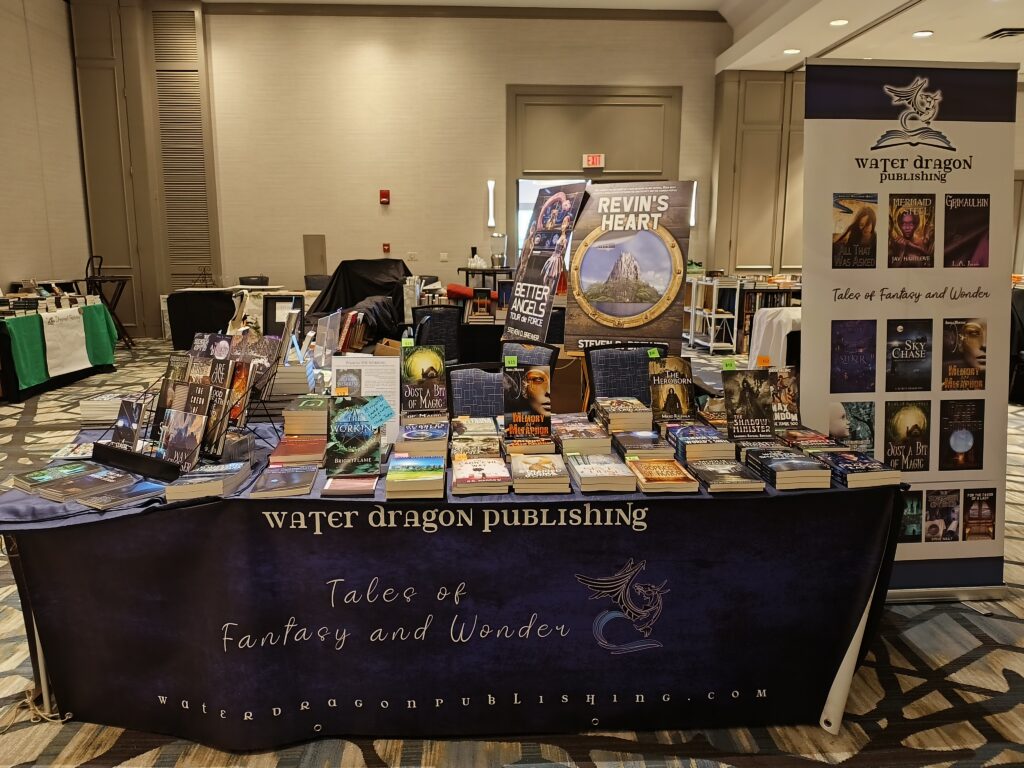
To start selling, you should assemble some basic supplies. A tablecloth or table runner can help give a professional appearance. It’s worth getting a point-of-sale app for your phone and an envelope with small bills to make change. Business cards, bookmarks, stickers, or other giveaways are useful to help people remember you. But once you’re set up, you still need to actually try to sell.
Selling does not come naturally, and many authors choose to leave selling to others. But as with anything else, selling is just a skill that one can learn and develop with practice. Learning how to find a hook, make a pitch, and close the sale can help you sell books like a pro.
Finding a Hook
An effective hook—a way to engage with people passing by the table—is a key to success. I have seen authors literally hiding behind stacks of books or signs to avoid interacting with passersby. I find that nearly every sale I make is due to reaching out to get people to give my books a second look and let me make a pitch.
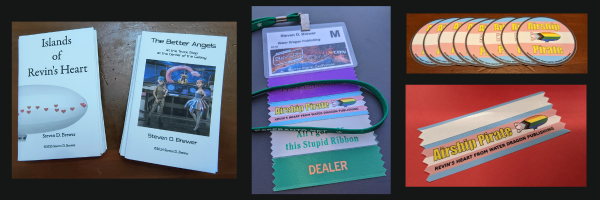
For the 2022 Worldcon in Chicago, I designed badge ribbons for my book Revin’s Heart that said, “Airship Pirate.” As people passed by my table, I asked, “Would you like to be an airship pirate?” and pointed at the ribbon. Unsurprisingly, nearly everyone at Worldcon wants to be an airship pirate. While they were taking the ribbon, I had a chance to explain what the ribbon was for and make a pitch for my book.
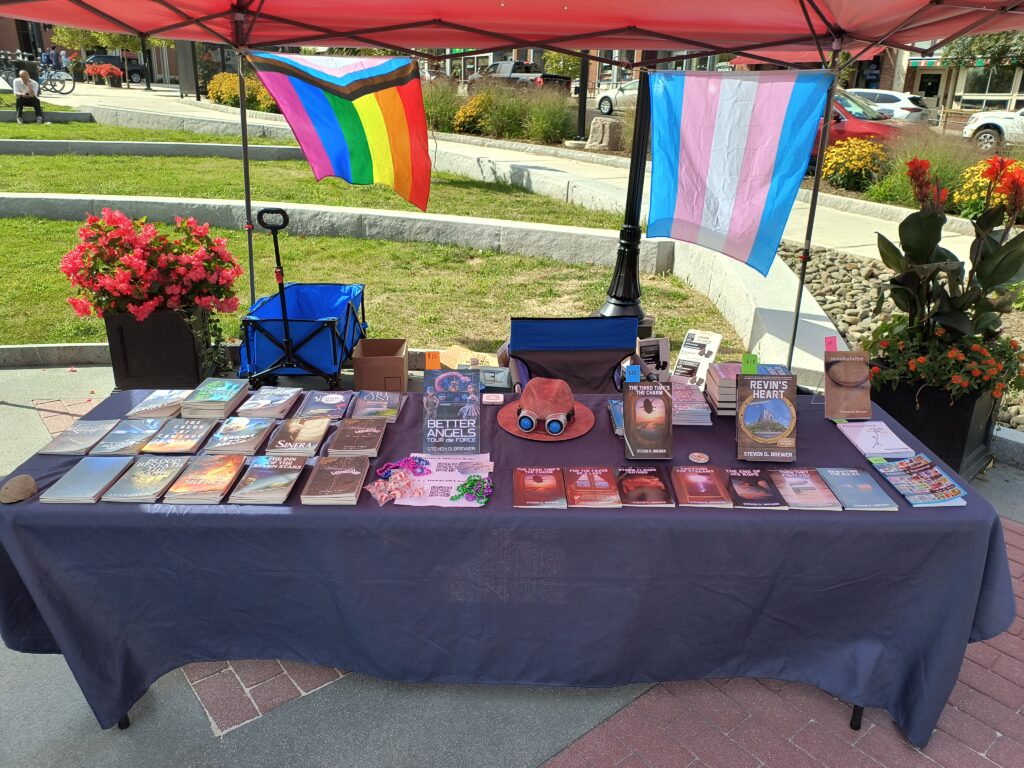
At local, non-genre events, where not everyone wants to be an airship pirate, a more general hook is more likely to be effective. I have had good success simply asking, “May I tell you about my books?” Most people are interested in hearing about books directly from the author. Very general opening questions, such as”What do you like to read?” can work well for some people. Nearly anything you can do to break the ice will give you the chance to make a pitch and close a sale.
Making a Pitch
Making a concise, polished pitch, delivered as a performance, is perhaps the most important part of selling books. Your pitch should be rehearsed and avoid verbal tics such as “um” and “uh.” Ideally, the performance will draw the listener in, and you can adjust your cadence to match their reactions, speeding up or slowing down as needed. The pitch itself can be divided into two components: a statement that expresses the genre and a brief teaser of the story.
Coming up with a catchy way to convey the genre is best. My work, which often blurs genre boundaries, provides me with an opportunity to say something unexpected or offbeat, thereby attracting interest. I describe Revin’s Heart as “a steampunky, fantasy adventure” and Better Angels: Tour de Force as “fluffy, military space opera.” These help set readers’ expectations about what follows and can pique curiosity, leaving room for imagination.

Another way to express genre is by comparing it to other works. Author Elaine Isaak says of her book, A Wreck of Dragons, “It’s like Pacific Rim meets How to Train Your Dragon.” Bam! It gives people an easy way to visualize what the book is about.
The teaser is less a synopsis or summary of the story and more an opportunity to briefly touch on characteristics that might appeal to the reader, leaving the rest up to their imagination. For Revin’s Heart, I merely say, “It has pirates and airships and a trans protagonist.” Author LA Jacob, who introduced me to hand-selling books, developed a very effective teaser for her series:
Grimaulkin is a young, gay mage who summoned DEMONS and was sent to prison for it. Now he’s out and is trying to make a better life for himself, but no one will trust him BECAUSE HE SUMMONED DEMONS.
The teaser invites the reader to visualize where the story could go. Their own imagination can sell the story far more effectively than anything you could say.
Closing the Deal
So you’ve made your pitch, and someone is looking at your book… How do you close the deal and make the sale? My experience is that there’s nothing more you can really do. People either sell the book to themselves or they don’t. But don’t be discouraged if people don’t immediately purchase your book.
If your pitch has done its job, they’ll still be thinking about your book long after they’ve walked away from the table. Many people walk through and look at all of the books before they make any choices, so they may yet come back to buy yours. And many people don’t buy paper books but prefer to go home to purchase ebooks online. Cards, bookmarks, stickers, or other giveaways can ensure people take something with them that will help them remember and find your books later. Make sure to include a URL or QR code so they can easily find your catalog.
Benefits of Hand-Selling
Although I say “for fun and profit” in my title, most new authors are unlikely to make much money selling books at a convention or market. With any luck, you will make back the table fee. But considering the cost of travel, lodging, and expenses during the convention—not to mention the hours spent loading in, selling books, and loading out—you will probably come out in the red.
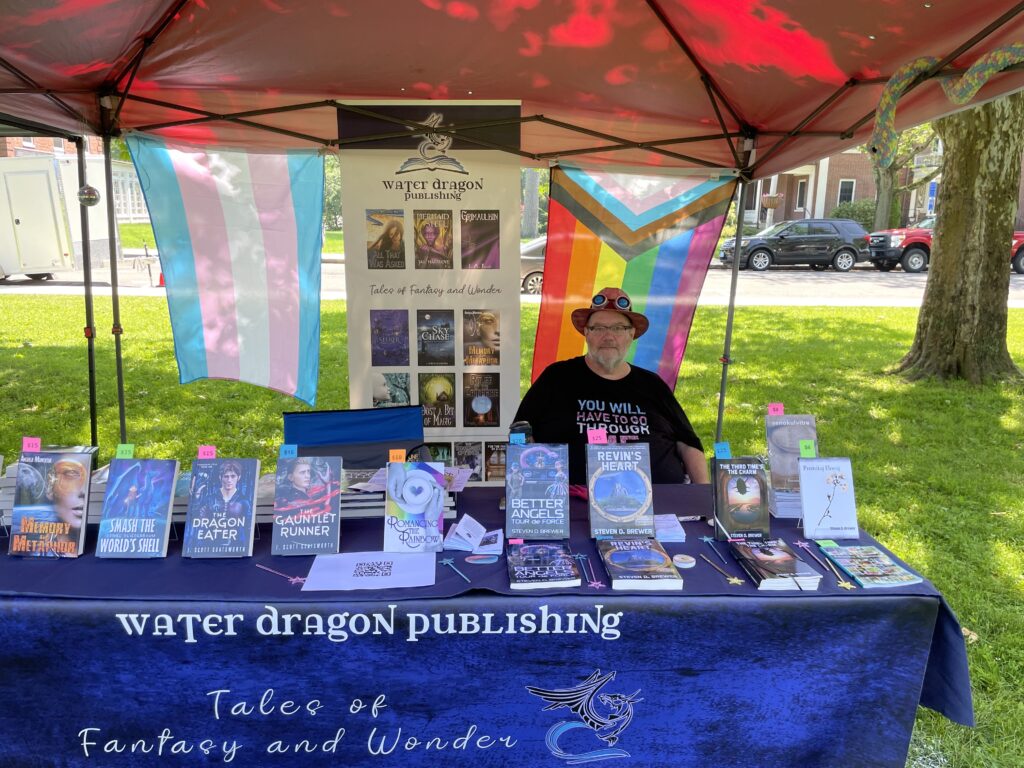
So why do it? It’s an opportunity to get your book in front of the most passionate readers in your genre. They’re the ones who, if they appreciate your work, are most likely to talk up your book or leave a review. Dealer’s rooms are also full of other authors and bookselling professionals, which offers unique opportunities to network at length. Moreover, nearly everyone at the event will cycle through the dealer room at some point, giving you a chance to meet a vast number of people—and show them your work. Finally, as I said, it’s fun! Showing off your work, seeing the wonder in people’s eyes when your pitch lands, and having them purchase a signed copy are all extremely rewarding. And when someone comes up looking for your work or asking for you by name… Well… It makes it all worthwhile.
Explore more articles from Making the Sale: Marketing for Creators
 Steven D. Brewer (he/him) is SFWA Secretary and, as a faculty member, both teaches scientific writing and serves as Presiding Officer of the Faculty Senate at UMass Amherst. He is the author of Better Angels: Tour de Force, Revin’s Heart, and the forthcoming A Familiar Problem, published by Water Dragon Publishing. Brewer identifies diverse obsessions that underlie his writing: deep interests in natural history, life science, and environmentalism; an abiding passion for languages; a fascination with Japanese culture; and a mania for information technology and the Internet. Brewer lives in Amherst, Massachusetts, with his extended family.