
by Rebecca A. Demarest

Editor’s note: This article is a follow-up on the 2025 Seattle Worldcon panel “Giving and Receiving Feedback for Poets,” with panelists Dawn Vogel, F. J. Bergmann, Holly Lyn Walrath, Vanessa MacLaren-Wray and moderated by Rebecca A. Demarest.
We’ve all been there: An acquaintance asks us to review a poem. If you’re anything like me, warning klaxons go off in the back of your head, and Admiral Ackbar screams about traps. Do you tell them what they want to hear? Are you going to be honest about how much you dislike the metaphor involving slug slime and new love? Let’s face it, poetry is an intensely personal and moderately subjective form of self-expression, which means the feedback we give (and receive) has the power to hurt.
So what do you do? Ink and run away? Take the plunge and give honest and constructive feedback? If you are brave enough to take the second option, here are some helpful tips to ensure that both of you walk away from the experience feeling satisfied.
Set Expectations
Whether you’re sitting at a workshop roundtable or your aunt has mailed you a packet of poetry about her Shih Tzu, always start by setting expectations. Ask the poet what kind of feedback they are looking for. Here are some possible questions:
- What kind of feedback are you looking for today?
- Do you want my general impression of the piece or something more detailed?
- Do you want to know how it affects me?
- Do you want feedback on the success of various techniques you used?
Once you’ve established the kind of feedback they are looking for, make sure you also know the parameters around the piece you are reading:
- Is this poem for a particular publication or event?
- Did you use a traditional form for the poem?
- Is this poem referential or in response to something?
- Do you prefer written feedback on a separate document, in-line comments, or a conversation?
All of these questions help to adjust the way in which you approach critiquing to ensure that the feedback you give will actually be helpful.
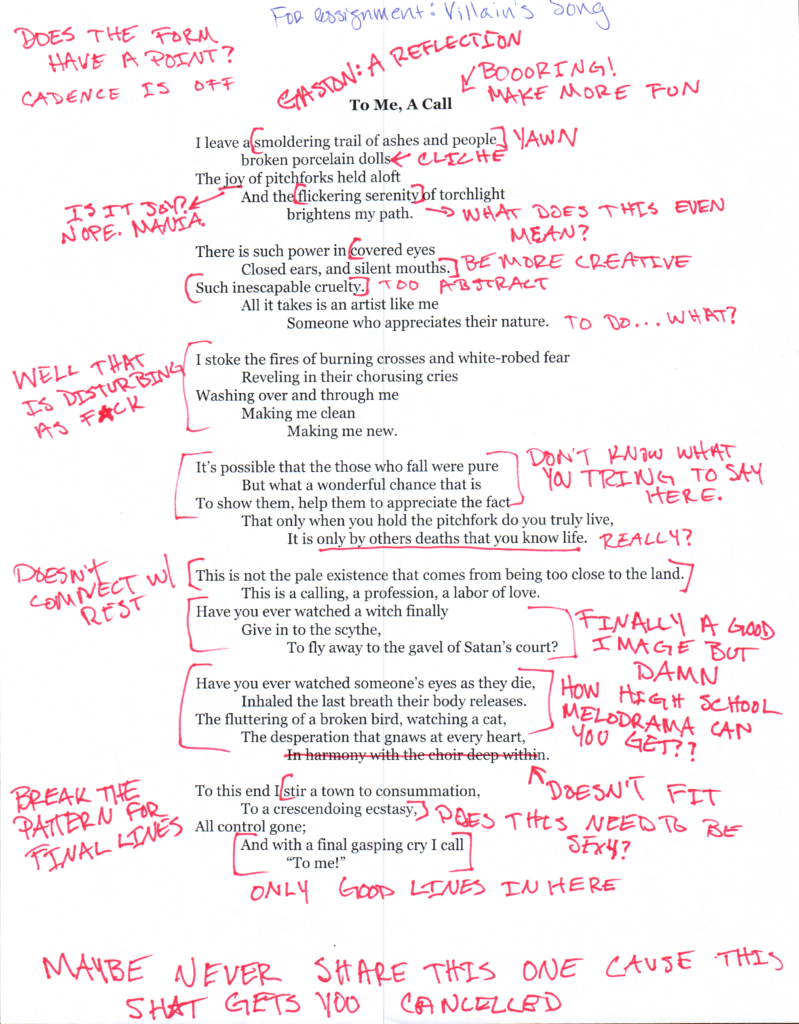
Seriously, don’t be this guy. The comments are rude and entirely rooted in the editor’s view of what they believe should be on the page, not trying to edit for what the poet is going for.
Framing Your Feedback
Once you know what aspects of the poem you are focusing on, the next step is framing your critique. Because poetry is often so personal, it is essential to frame your feedback with respect and care. If you have a long-standing relationship with the other party, you will develop a unique dynamic in which you might share feedback such as, “I’m not sure if it’s the turbulence on this flight or this stanza, but something is making me nauseous,” but outside of an established friendship, that sort of feedback is more often than not going to make someone mad.
Instead, lean in to phrasing your feedback as an opinion and/or a question:
- This metaphor didn’t work well for me. I didn’t quite understand what you were going for. What feeling are you trying to evoke?
- I lost the meter in this line; what if you switched these words around?
- With the title, I was expecting something different because of the connotations in my head for those words. What were you going for specifically?
Also note how that feedback is based on a concrete moment on the page. Specificity is a wonderful tool and should always be used when giving feedback. This is because general vibes such as “I liked it,” or “I’m not sure it’s ready,” don’t actually offer anything for a poet to address and can be frustrating. In addition, offering follow-up questions as part of the feedback can help the poet think about possible solutions to the perceived problems.
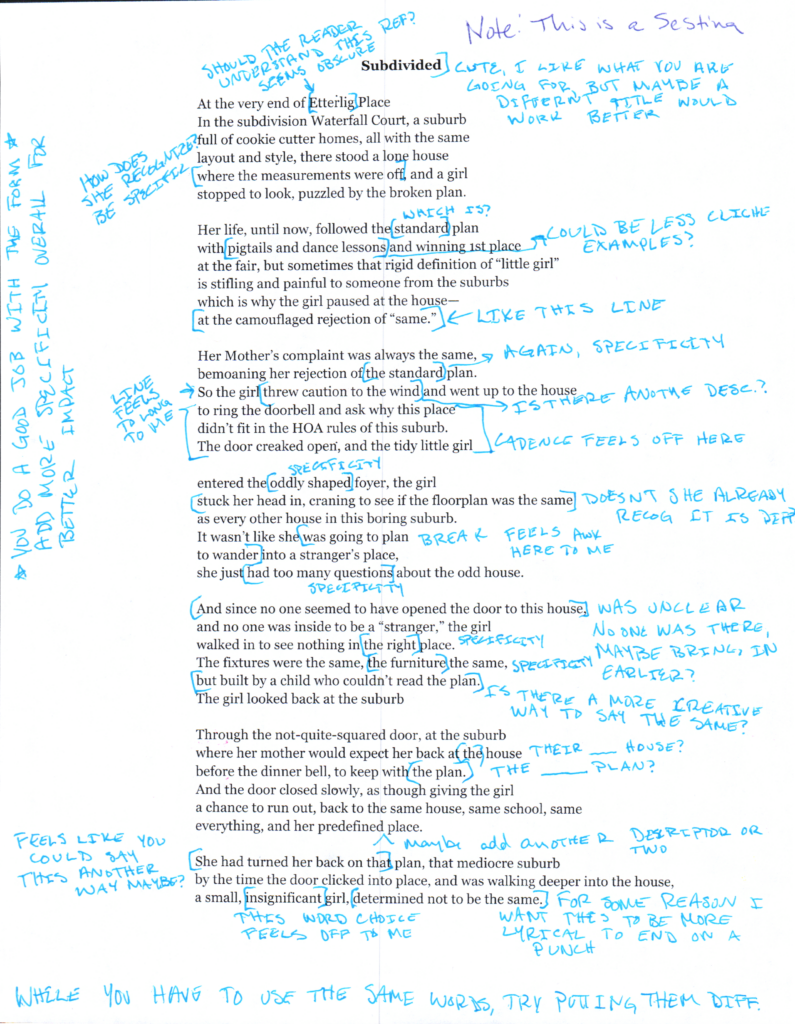
This editor has taken into account not only the poet’s note about form but has also offered universal comments (noted in-line for helpfulness) and opinion in the form of questions. A much better (and nicer!) editor.
When You Ask for Feedback
If you’re the one asking for feedback, the first thing you need to ensure is that you are in the right headspace to receive folks’ opinions. Do not ask your work-friend what they thought about your poem at the end of a long workday where you skipped lunch. You’re hangry and tired, and anything Barbara from Accounting says at this moment is likely to be frustrating.
Instead, share your work only when you can honestly say you are ready to edit the poem. Cultivate in yourself a desire to make your poems shine. This may take some effort on your part to embrace the imperfect nature of writing. First drafts are—and should be—utter rubbish with a few hidden gems. Second drafts get better, and third, but you won’t ever know if the poem is communicating what you want it to say if you haven’t at some point shared it with other people.
That raises the question of motivation. Are you writing poetry for yourself in an effort to process heavy emotions? Then you likely don’t need or want intensive critique and should tell your readers that you’re sharing not for edits but for the sole satisfaction of having another person read your work. On the flip side, are you aiming for publication in literary journals around the globe? In that case, strap in and put on a poncho; you’re in the splash zone and about to get dirty. Prepare yourself to rip that poem apart again and again with the help of your fellow poets to polish it to a mirror-bright shine.
In all of this, remember that you and your fellow poets are sharing a piece of your soul with the world. Treat each other with kindness and respect, and together we can help one another’s work reach a brilliance that a poet alone struggles to attain. And if you’d like a fun suggestion to help you feel more comfortable giving and receiving feedback on poetry, I can personally recommend bribing your non-poet friends with their favorite food or drink and then workshopping your poem. The results can be hilariously—and unexpectedly—useful.
Explore more articles from SPECULATIVE POETICS
 Rebecca A. Demarest (she/her) is an award-winning author, poet, playwright, book designer, and writing instructor living in Seattle, WA, with her husband and three muppets. Her work has appeared alongside authors like Cat Rambo, been dramatized for the stage and NPR, and her novels are available at your favorite bookstore. When not being held hostage by words, you can find her tending to her indoor jungle, crafting, sewing, playtesting tabletop role-playing games, and failing to teach her dogs new tricks. For more information on her work, please visit rebeccademarest.com or follow on BlueSky @writerlybliss.