by Michael Capobianco

Giving democratically chosen awards for writing isn’t easy. When the authors themselves are designing the process, there is additional pressure to make the process “fair.” It was even tougher before the Internet, when nominations and updates had to be mailed. In what was then called Science Fiction Writers of America, a small group of dedicated volunteers carried most of that burden. They were the Nebula Awards Report (NAR) Editors.
Creation of the Nebula Awards was suggested by SFWA’s first Secretary-Treasurer, Lloyd Biggle, Jr., as a way to collect the contents of an annual award anthology that would help fund the nascent organization as well as promote the best science fiction. Founder and then-SFWA President Damon Knight ran with the idea, and the Nebula Awards were born. Modeling them from various sources, including the decade-old Hugo Awards, the awards would be voted on by the Active and Associate Members of SFWA. The first vote would be for works published in 1965 and there would be a Nebula Awards Banquet in Spring 1966. From the very beginning, the process involved the publication of nominees submitted by members. The first set of Nebula rules was published in the September 1965SFWA Bulletin and included:
“6. All SFWA members in good standing, whether active or associate, may nominate and vote on stories and novels. Stories and novels may also be nominated, but not voted on, by the editors and publishers who originally published them. Such nominations will be accepted from one representative of each publishing firm.”
“7. Nominations will be published, and ballots distributed to members, in the November 1965 issue of the Bulletin. If three or fewer nominations are received for any story or novel, the names of those making the nominations will be listed in the Bulletin.”
A 1965 nomination ballot for short story, “novelet,” and novella was mailed with the November 1965 SFWA Bulletin. Nominations for novel would continue until December 30. These ballots were to be returned to a law firm for unbiased counting. Time was tight. Final votes would happen in February 1966 and the Nebula Awards Banquet was scheduled for March 11. (Read more about the inaugural ceremony in “A Brief History of SFWA: The First Nebula Awards” by Michael Capobianco.)
The January issue contained the first recommendations for 1966 along with a request from President Damon Knight:
“Members are asked to drop the Bulletin a postcard whenever they read an outstanding science fiction story or novel. If this procedure is confirmed when we vote on it in March, it will become part of the SFWA Awards nominating system; even if not, I think it will be a valuable service to members.”
Knight primed the pump with the first nominations for 1966, for “Apology to Inky” by Robert M. Green, Jr. (F&SF) and “An Ornament to His Profession” by Charles L. Harness (Analog).
The winners for 1965 were announced in the April 1966 issue (which included coverage and photos from the New York and Los Angeles Nebula Banquets) and, importantly, the first list of new Nebula nominations for the year 1966. It included nine recommendations from four members: six by James H. Schmitz, two by James Blish, and one each by Greg Benford and John Brunner. The June 1966 issue contained six recommendations; August’s had 20 nominations, several with more than one nominator; September’s had 11 and November’s 11. At this time, SFWA had approximately 200 members.
For whatever reason, the Final Ballot for 1966 was underpopulated, with only three candidates each for novel, novella, and short story. Knight’s two recommendations made the final ballot but didn’t win. James H. Schmitz’s nominee for best novel, The Last Castle by Jack Vance, made the ballot and won. (For more on the Nebulas’ physical look, read “Planets and Plastic: A History of the SFWA Trophies and Awards” by Michael Armstrong.)
From this distance, if the process was supposed to let members know of worthy prospects, it looks pretty shaky. No listings for the 1967 Nebulas were published until the August 1967 Bulletin, which included a more formal listing of nominees by category and had 20 entries. October had 30, and December another 18. Nominating was catching on. In 1968, the rules were revised and regularized, with, significantly, the addition of Rule 4.(c):
“Any title receiving a total of three (3) or more nominations will be considered to qualify for placement on the Ballot in its appropriate category. Any title with fewer than three (3) nominations will be disqualified.”
Now a single recommendation wasn’t enough, and so recommendation counting became a group pastime.
The last full list of Nebula recommendations in the SFWA Bulletin appeared in issue 41/42 in July 1972. It was accompanied by a note saying that Vonda N. McIntyre was now assisting Hal Clement in preparing the list.
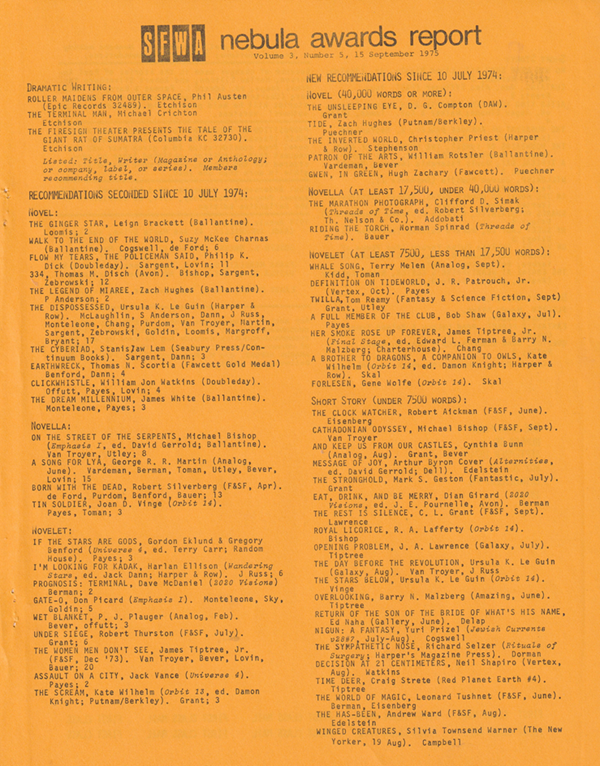
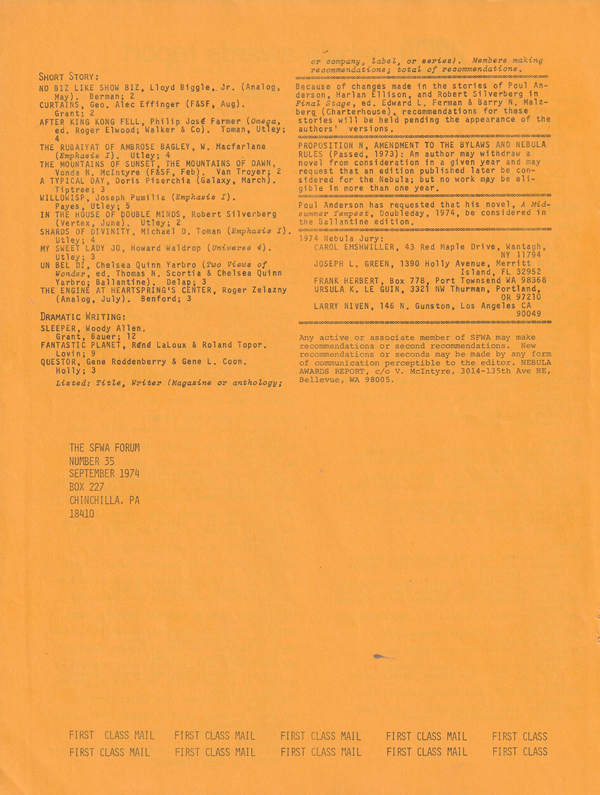
Then the crystal ball grows hazy. SFWA has a complete run of Bulletins, but it’s missing some issues of its other publications from this time. The next time we encounter the NAR is the September 1974 issue of the SFWA Forum. Vonda N. McIntyre is the editor and nominations go to her. She has created a distinctive heading and the contents are well-organized. This basic format (see photos) will persist right to the end of the NAR in 2008.
This stand-alone NAR is among the most ephemeral of SFWA’s publications. None of the original paper copies have survived in SFWA’s archives. Frank Catalano, who edited the NAR in the early ’80s, tells what it was like to edit and mail it.
“What I remember the most was the physical challenge of actually getting the report out the door. I will qualify this by stating my memory of the details of the process, 40+ years ago, may be flawed. But I recollect that Nebula recommendations would come in on postcard, mostly, some by letter. They’d be tallied and organized, and then printed on multiple sheets of letter-sized paper, folded in half, stapled, labelled, stamped and mailed. Among those who’d show up for these mailing parties at my apartment were Vonda N. McIntyre and, I think, Greg Bear. (…) What I remember the most was just the camaraderie and conversation. The need to get it right. And all of the damp sponges required to attach the stamps.”
Seven SFWA volunteers have been given the Kevin. O’Donnell, Jr. Service to SFWA Award because of their work on the NAR: Chuq Von Rospach (NAR Editor 1989–1996), Brook and Julia West (NAR Editors 1989–2008), and Vonda N. McIntyre (NAR Editor 1972–1976). Other members who have taken a turn: C. L. Grant, George W. Proctor, Frank Catalano, Elizabeth Waters, Orson Scott Card, and Mark Van Name.
So, why did the NAR end? Rule changes made the Nebula more and more cumbersome to administer, and the awards were no longer tied to a specific year. Former SFWA President and current SFWA Operations Manager Russell Davis offers this summary: “The Nebula Award rules when I took office in 2008 were extraordinarily convoluted.” In 2009, the nomination process changed to the simpler one still in place in 2026.
Explore more articles from THE HISTORY FILES
 Michael Capobianco is co-author, with William Barton, of the SF books Iris, Alpha Centauri, Fellow Traveler, and White Light. He has published two solo science fiction novels, Burster and Purlieu as well as short fiction. Capobianco was President of SFWA from 1996 to 1998 and again in 2007–2008. He currently serves as SFWA’s Authors Coalition Commissioner, Chair of SFWA’s Contracts Committee, Co-chair of SFWA’s Legal Affairs and Estates-Legacy Committees, and is a member of SFWA’s History Committee.