Welcome to the Advocacy Corner. Over the coming months, we will populate this central hub with more advocacy and writer-defense resources and organizational updates. The following information highlights just some of the work we have underway early in 2026. Bookmark this link and check back soon for more!
AI Working Group FAQ
SFWA recognizes that the landscape, definitions, and use of generative AI and LLMs are currently in a place of rapid change.
We seek to develop policies and processes that recognize and safeguard human-created works.
Below, you will find information from our survey [link] as well as guidance, resources, and processes to help you navigate your nominations and develop your own creative work.
Over the coming months, we will continue to build our growing library of resources to help you navigate our changing industry.
We look forward to reading, watching, and playing what you, as a human, create.
The SFWA Survey on LLM Use in Industry was released on December 22, 2025, via the SFWA website. It poses several multiple choice and free answer questions, focusing on the intersection of AI/LLM use with personal and professional writing practice. The survey remains open to members of the public as well as SFWA members.
At the time of writing (Feb 9, 2026), there have been 1,930 responses.
The survey’s scientific accuracy is less important than the information it provides SFWA as we consider the impact of AI and LLM’s on our industry and how we can protect, celebrate, and defend human-authored work. Your perspective here matters and informs decisions going forward.
The survey is still open, and you may submit your own response here. The labels on the charts shown in following tabs represent abbreviated versions of the answer options for legibility purposes.
Figure 1 shows responses to the question “Which of the following most closely resembles your stance on AI/LLM use?” The choices shown on the chart are abbreviated versions of the full options below.
Fig 1.
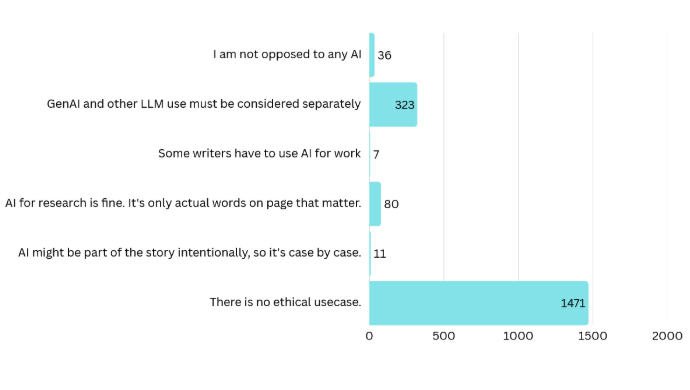
The question depicted in Figure 1 was answered with the expectation that the respondent could then leave a longer, qualitative response explaining the extent to which their view differed from the chosen quantitative option.
- I am not opposed to the use of LLMs in any capacity in the creative process.
- Putting aside the historical and environmental issues, Generative AI needs to be approached differently from other LLMs, because other forms of LLM sometimes show up in tools (e.g., spell-check, grammar-check, translation software) that are normal parts of a writer’s workflow.
- Some writers are working for companies that make choices about AI without their involvement in the decision-making process, and this matters when deciding how we respond to the presence of AI in their work as individual creators.
- The use of any AI system for any part of the writer’s workflow that is not the writing itself (so, including brainstorming and research phases) is perfectly fine. It is only the words on the page that matter.
- There are cases where the use of Generative AI for active storytelling might be a critical part of the story we want to tell, so it’s really a case-by-case determination.
- There is no ethical use-case for writers, because this technology was developed through piracy and/or continues to negatively impact environmental systems and marginalized human beings.
Figure 2 shows how respondents have changed their writing practices based on reactions to AI/LLM presence. Again, the chart shows abbreviated versions of the responses.
Fig. 2.
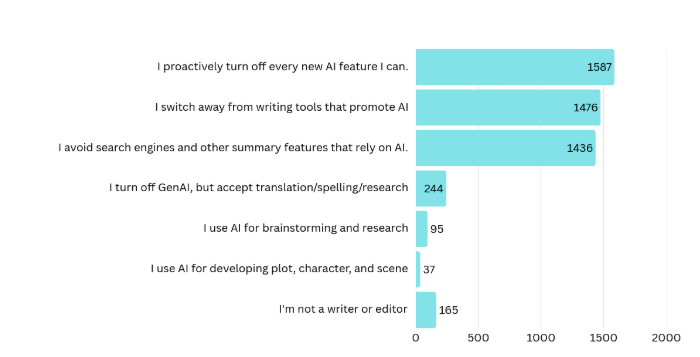
- I proactively turn off every new AI feature I can.
- I switch away from writing tools that promote AI integrations wherever possible.
- I avoid search engines and other summary features that rely on AI.
- I accept AI features selectively, avoiding or switching off all the Generative AI tools I can identify, while leaving translation, spelling and grammar, and/or research assistants mostly intact.
- I engage with AI chat features to brainstorm story elements, and/or for research questions of relevance to my writing.
- I have used Generative AI for the development of story plots, characters, and/or scene construction.
- I’m not a writer or editor.
Below, you will find guidance as well as resources and processes to help you navigate your nominations and develop your own work. The examples are not all-inclusive, and Nebula Award nominations and ballot decisions will continue to follow our documented processes, including selection and appeals.
SFWA’s emphasis for the Nebula Awards is on human creation. We want to recognize writers for their works and celebrate their work in the genre. The guidance presented here was developed by the SFWA Board in consultation with the AI Working Group, the Emerging Tech Committee, the SFWA Awards Rules Committee (SARC) and the Nebula Awards Commissioner (NAC). If you have an individual nomination question, we encourage you to follow up with the NAC at nac@sfwa.org.
Our Nebula Rules state:
- Works that are written, either wholly or partially, by generative large language model (LLM) tools are not eligible.
- Further, works that used LLMs at any point during the writing process must disclose this upon acceptance of the nomination, and those works will be disqualified.
Further Guidance
SFWA requires that work be human-created to be eligible for the Nebula Awards. As you consider your award nominations and develop your own work, you should be aware of what constitutes human-created work.
The following example uses of Generative AI (including Large Language Models) would be disqualifying:
- The creation of any draft language.
- The automated transformation of any language including:
- Tone and style modification (for example: asking an LLM tool to make a passage more aggressive in tone or writing a passage in the style of another author).,
- Summarizing and rewriting segments (for example: asking an LLM tool to rewrite for consistency in language).
- Copy and pasting text from a generative AI into a draft.
The following example uses are considered generally acceptable within the Nebula rules:
- Spellcheck.
- Rules-based editing tools.
- Standard rule-based software.
- Database searches.
- Accessibility tools (insofar as they do not violate the above guidance).
While it is impossible to perfectly determine if a work is written, either wholly or partially by generative LLM tools, or if they were used during the writing process, SFWA supports the good faith statements of authors in both the writing of and nomination of Nebula submissions.
Appeals Process
Below, our Nebula Awards Commissioner offers further guidance on the Nebula Appeals Process.
About the Process
At the end of the SFWA rules is an important section that deals with what happens when someone wants further advice or a decision reviewed. This section states that the interpretation of the rules, and all questions regarding eligibility, withdrawals, nominations and ballots, etc. shall be decided by the Nebula Awards Commissioner (NAC). If anyone has questions or concerns regarding the submission of eligibility of their work or another’s work, we encourage them to reach out to the NAC, who is currently Marcus Whitnell, at nac@sfwa.org.
If a nominated work is deemed ineligible, every effort will be made to notify the creator. Anyone unhappy with a decision the NAC makes, be that regarding the eligibility of a work, or nomination / ballot ruling, has a right of appeal (that the NAC will happily facilitate) to the SFWA Awards Rules Committee (SARC). The SARC will review the decision(s) against the Nebula Rules and provide a judgement.
If there is still a disagreement, it is possible to appeal to the Board of Directors, who will consider the SARC’s judgement, either concurring with their view or putting the matter to a full board vote (following due consideration of all viewpoints).
In a professional landscape that is undergoing significant change in terms of technological innovation and interference, getting the balance right is critical to a process that is fair for everyone invested in personally creating original works of science fiction and fantasy that uphold the truest traditions of the Nebula Awards.
Notes from our Partner Organizations
SFWA was recently at the Author Coalition Annual Meeting in New York. In discussion, Author’s Guild used the term de minimus when defining what is still eligible for human-authored certification in their purview. You can find more of their resources and guidance here.
Many other author organizations and award-giving organizations were similarly aligned in their perspectives on the use of Gen AI and LLM’s, so SFWA continues to encourage writers who are actively using Gen AI and LLM’s to consider the long-terms ramifications of their use on their professional careers, including lack of eligibility for awards and contests and issues with copyright on works they produce.
Developing Resources
SFWA’s Emerging Tech Committee is developing the following resources, which will launch and be built upon in the coming months:
- An AI terms table, defining various LLM technologies.
- A reference library of common creator tools with LLM presence, which uses the above definitions to explain their level of LLM integration, then offers guidance for how to turn off AI components and/or find human-first alternatives. This library will include:
- Tools for storybuilding, from research to drafting.
- Tools for supplementary work like translation, spellcheck, and marketing.
- Broader software like professional platforms and search engines.
- AI detection tools and other counter-AI products, many of which present their own data security risk factors and funnel more data to AI models.
- A reference library that flags recent news items and active court cases for creators following the state of copyright in relation to AI.
- Contract support, through a list of relevant regional laws and an exploration of strong and weak AI clauses as they relate to the protection of an author’s work.
- Broader subject explainers, after the more concrete table work has been implemented.
- Links to relevant materials and human-first declarations from literary peer groups.
The aforementioned reference guides will occupy a more permanent home at our website, to serve the following four core demographics:
- SFWA members looking to make more informed, human-first choices in their practice;
- A broader community of readers and writers seeking guidance on the use of LLMs and how to choose more human forms of creative expression;
- SFWA volunteers and staff, with a special focus on people implementing SFWA’s publication programs: Planetside, NRN, G&CQ, and the NetGalley Partnership Program;
- Educators and students, who often turn to SFWA.org for resources for teaching plans and need professional support to (re)focus on human-centered creative practice.
The Emerging Tech Committee is also implementing a first-ever annual audit of SFWA’s tool stack, to optimize our use of human-first technologies.
SFWA Members, we need your feedback!
(If you cannot see the survey below, please log in at the top of the page first.)