
by Misha Grifka Wander

One of the joys—and challenges—of self-publishing is finding a cover for your work. But not all authors have a full understanding of the cover design process. That’s why it’s worth asking a cover designer. By interviewing veteran illustrator and designer Jeff Brown, I’ve obtained a few key pieces of advice.
You only have to wander through a bookstore for a moment to realize that, whether or not we “should,” we absolutely do judge books by their covers. This is because in a world flush with options, readers are looking for a first impression that gives them an immediate idea of whether they’re interested in finding out more, or if they can move on to the next book. Brown pointed out that “The quality level of the cover, people assume, is the quality level of the book.” Even if that’s not true, a beautiful cover will draw people in.
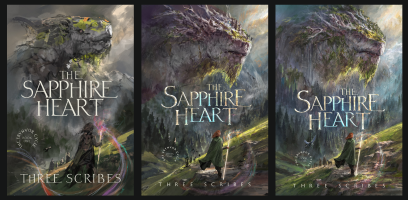
The most important thing about a book cover, according to Brown, is that it represents the genre and tone of the book. It is the easiest way you have to reach your ideal readers. That’s one reason why it’s not necessary to follow cover art trends, Brown said. If it looks good and represents your book well, it’s doing the job it needs to and won’t go out of style.
Understanding the purpose and importance of book covers helps authors find a good designer too. When Brown works with an author, he says they “both want the same thing for the book: the coolest possible artwork for the cover, so that it looks amazing and it sells.” That means that a good artist might actually push back on the author’s ideas if they believe it won’t be a good fit from a marketing standpoint. That doesn’t mean they must push back, but that it’s worth having a mutual brainstorm about the marketability of your cover. Brown gave a common example: Many writers might want their cover to reflect an important moment in their book, but if that scene doesn’t happen to have a dynamic setting or interesting posing, the potential reader doesn’t have the context to understand what is supposed to be compelling about that image. Instead, a good cover artist will understand how to convey the gist of your work without necessarily borrowing directly from the text.
In the age of e-commerce, it’s also vital to consider how a cover will look on Amazon or other websites with small thumbnails. Many potential readers will see your book at a one-inch size before they see a full-size version, and it needs to still stand out and be legible. “Thinking of that one-inch size is the priority,” Brown said. Accordingly, he recommended streamlined, iconic compositions that use dramatic contrast to direct the eye. Details can certainly be present, but should serve the overall iconic composition. He also noted that the first cover of a series is especially important, as the whole series will be sold on that basis.

It’s also important to know how to find and approach a cover designer. Brown laid out a few important tips for hiring the right artist:
- It takes time and money to find the right designer. Find someone who fits the book, not just the first person to say yes.
- Approach an artist by pointing out pieces from their portfolio that resemble what you’re going for. If they haven’t done something that looks like what you want, consider finding someone who has.
- If you have a smaller budget, devote time to finding lesser-known artists. There are great people at all price points, but they may still be building their careers.
- Bring some passion and excitement to your conversations with a designer. Brown said, “When I see authors deeply excited about the project, it makes me excited to work on it.”
- Give the artist some level of freedom. The cover is successful not if it looks exactly what you thought it would look like, but rather if it works to sell your book to a new audience.
Brown emphasized that there’s a great cover designer at every price point—and I would add that supporting other independent artists in other mediums is something to feel good about as an author.
Our conversation also touched on the use of AI art in the cover design industry. While many cover designers, including Brown, initially feared for the future of their careers, the higher-end designers have found that readers and authors still prefer human-made art. That said, many large companies that sell covers are using AI, and more concerningly, Brown said, “some people don’t even know they’re getting AI-made covers.” If you are looking for a cover and don’t want to use AI art, make sure to investigate the policies of the company you’re purchasing from or the designer you’re working with. Pre-made covers are especially likely to have AI elements.
Ultimately, Brown made the case that investing in a good cover is investing in your career as an author. “The book cover and the editing are the biggest investments you can possibly make in the success of your book,” he said in closing. “If you’re thinking of being an author as a long-term business, invest in that, because that’s the way people will see you.”
Explore more articles from Making the Sale: Marketing for Creators
 Jeff Brown has worked as a science fiction and fantasy illustrator and cover designer since 2013. He has been a Dragon Award finalist in 2023, 2024, and 2025 for Best Illustrative Book Cover. He has always been a big SFF fan and grew up drawing swords, dragons, and castles. His favorite part of illustrating is creating a sense of awe in his images. He loves creating epic scale in his scenes, and any kind of giant monsters…especially dragons. He lived for the past 12 years in Mexico and is now back home in Saskchewan, Canada, with his wife, Sarai, and his son, Jacob. You can see more of Jeff Brown’s work at jeffbrowngraphics.com.
 Misha Grifka Wander (he/they) is a writer, designer, and editor based in the American Midwest. They obtained a PhD in English from the Ohio State University focusing on contemporary global speculative fiction and catastrophe. Currently, they work in operations at SFWA and serve as part of the editing collective for Hugo-nominated magazine Ancillary Review of Books.