by Brenda W. Clough
Why Read Aloud?
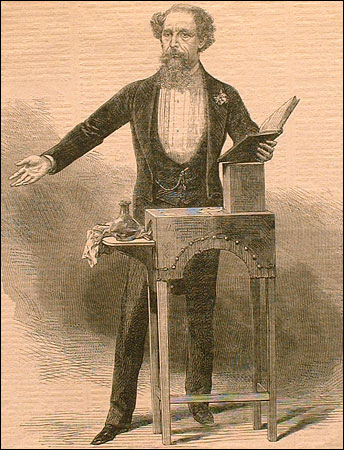
Many great writers never did. J.R.R. Tolkien was reportedly awful in lecture halls, speaking in a fast mumble to his necktie. On the other hand, Charles Dickens made a second fortune reading aloud, packing halls at home and abroad with fans who heard him read about Tiny Tim or David Copperfield. Which is why we do readings—they’re a time-tested way to connect with readers. People listen to you, they cry, “But wait, what happens next?” And they zip out and buy your book.
Where Should I Read?
Conventions, both in-person and online, often have a readings track. Many writer or fan organizations offer them. For instance, Strong Women Strange Worlds has monthly readings online. The International Conference for the Fantastic in the Arts has a virtual convention every September, and readings are a popular program item.
In-person reading opportunities also abound. The Philadelphia Science Fiction Society has monthly meetings that often feature an author reading. Or how about the KGB in New York, or SFinSF, or the Brooklyn Books & Booze in Brooklyn?
Readings are a favorite event at bookstores. And if there’s a coffee shop culture in your town, Open Mike nights are the easiest on-ramp imaginable. You just show up on the night and step up to the mike. An online search should kick up any possibilities in your area.
What Should I Read?
People mostly don’t care whether what they’re listening to is published or not. But as an author, you might want to select something they can buy. Your new book or recent story could probably use a boost on Amazon. Listeners might yearn to hear you read from your classic 2009 space opera, but remind them you have a book out this year as well.
A reading should be reasonably understandable without a lot of explanation. Pick something suitable for a general audience. You don’t want to be obliged to describe the lineage of Aragorn, son of Arathorn. Skip the gory executions or the lurid sex. You want an easy on-ramp into your work.
But your selection should also accurately reflect the tone and subject of the work. If it’s a romance novel, read about the two lovers, and if it’s about Superman, have the Man of Steel appear. Otherwise, the audience may assume that your novel is about Lois Lane’s work life at the Daily Planet.
Time, Time, Time
The length of your reading depends on how much time you’re given, and that’s controlled by the event’s organizers. Ask them when you agree to do a reading. At a convention or a bookstore, they might allocate you half an hour; at a coffee shop open mic event, you won’t get more than 10 minutes.
Read your selection out loud, at home, in advance, timing yourself so that you can be confident you don’t run over. If you’re a little short, you can ask the audience if they have questions. But if you run long, you’re throwing the entire event off schedule. Help the organizers make the event run smoothly, and they’ll invite you back.
The Reading Copy
So, you chose a piece of your novel. Copy it out into a fresh document. Save this as a separate doc, the reading copy. Now you can kick it around. The first task is to add an introductory sentence or two, what you’ll say after you tell the audience your name. Here’s one of mine, selected at random: “This is from The Earl in the Shadows, a Victorian thriller. In this bit, Marian has vanished, and her sister Laura is frantic with worry.” All you need is enough to start the listeners off.
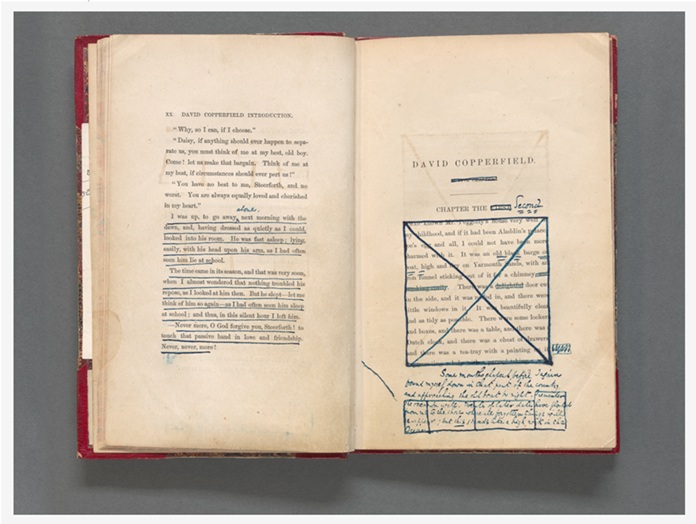
How about explanations? Charles Dickens’ reading scripts of Nancy’s murder from Oliver Twist survive. They’re visibly different from the text of the published novel. Dickens went through that climactic scene and added words here and there in case his audience hadn’t read the book. Bill Sykes, who? Nancy’s scummy boyfriend. The docks, where? In London.
Nor did Dickens hesitate to bob stuff out. He knew that listening is different from reading. He cut descriptions, trimmed lyrical musings about the weather, shortened moralistic digressions. Here’s a rendition of his reading of A Christmas Carol.
So go through your reading again and prune the words that don’t drive the reading forward—every place where the listener might lose interest or get confused.
How Will You Read?
Some writers read from their phone or laptop. But your devices are dependent upon connectivity. What if the coffee shop loses its Wi-Fi? And good luck balancing your laptop on that music stand. I have sat in an audience, unable to listen to the reader, tensely watching for his wobbling laptop’s impending crash to the floor.
Other people carry a copy of the book. Here, you must see your paper book page. And the lighting may be a single low-wattage reading lamp balanced on that inadequate, unstable music stand.
And what about those edits? You could print all your reading revisions onto a separate page, but you’d have to remember to look at it to say that Bill Sykes is Nancy’s criminal boyfriend.
To avoid all these terrors, you could print out your reading selection. A dead-tree copy is invulnerable against misfortune. Then you could:
- Pump the font up to 16-point, in case it’s dark or you break your glasses.
- Number the pages in case you drop them, and staple or clip them together.
- Write in the margins the pronunciation of strange words, so your tongue doesn’t slip.
- Bold the words you want to emphasize.
Wisdom Beyond Dickens
At a D.C.-area convention in the 1980s, Somtow Sucharitkul showed me all his readings in a three-ring binder. He inserted the pages into page protectors and wrote on the plastic with an erasable marker, noting places where he wanted to pause, slow down, or speak louder in that particular hall. Charles Dickens would have been awestruck!
I refined further on this by noting the read time of each reading on the first page. Then I order the readings by length into my binder. At any moment, I can whip out a reading of the required length. The binder is also a good place to store handouts, your bookmarks, or cards. And, you know how at conventions you have a name card, sitting in front of you at your panel? I keep mine. There’s one in my binder, in case I’m sitting at a table for my reading. They say that the customer needs to see the product a few times before they buy—that’s what advertising does. If the audience stares at my name as I read, maybe they’ll remember next time they’re on Amazon.
During the reading, make certain you’re audible. Do not emulate J.R.R. Tolkien! If there’s no microphone, speak up. Ask at the beginning if everyone can hear you. Look up every now and then to make eye contact with your audience. Somtow would remind himself by writing this into the margin of his reading copy. If there’s a microphone, gauge carefully the right distance for speaking. We’ve all sat in the audience when the speaker’s chin is knocking noisily against it.
And the most common listener complaint? It’s that the reader is reading too fast. Slow down! Write a reminder in the margin of your reading copy.
Afterward, thank your audience. Author Michael Swanwick has an alluring trick—he autographs his paper reading copy and gives it away, a great souvenir for a fan. Dickens never thought of that!
Explore more articles from Making the Sale: Marketing for Creators
 Brenda W. Clough is the first female Asian American SF writer, first appearing in print in 1984. Her 2025 novel is a science fiction novel, His Selachian Majesty Requests. In 2024, she published the 12th in the Marian Halcombe series, Servants of the Empress. A historical novel, A Door In His Head, won the 2023 Diverse Voices Award. Her novella May Be Some Time was a finalist for both the Hugo and the Nebula awards and became the novel Revise the World. She is active in the SF community, attending conventions and doing podcasts. Her complete bibliography is up on her web page, brendaclough.net.